Showing posts with label south sudan. Show all posts

Sunday, March 16, 2008

Memo From a Soldier's Grave


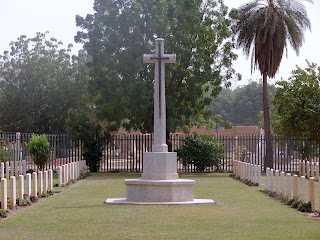
Khartoum, very much unlike the barren deserts of North Sudan and the swampy countryside of South Sudan, is a relatively "happening" place. It accounts for 80% of the country's (2/3 rd India's size) paved roads, 50% of its population and it's only decent airport. We were on our last trip to the city before our return home. After visits to the National Museum and the Nile confluence we were told of the Sudan War Cemetery, built by the British to honour the memory of those who laid down their lives during WW-II on Sudanese soil.

The fenced compound was well maintained, the tombs and vaults built in marble systematically laid out to aptly reflect marked reverence held for the heroes. While sauntering across, quickly reading through the epitaphs, the words "Om Bhagavate Namah" caught my eyes. The tombstone belonged to Sapper Appalaswami of Madras Sappers. The names of more Indian soldiers were etched on a huge memorial wall along with other officers and men whose bodies could not be identified. One felt truly proud of the valour displayed by our soldiers in an alien land and respect for the British system which valued the lives of each of its men and honoured their memory without bias or prejudice.


Let us briefly delve on what Appalaswami and his comrades did in Sudan. Italy's entry into the War in June 1940 threatened the British rule in Egypt and close the Mediterranean trade routes to Egypt, India and Australia. In early July the Italian East African Garrison launched attacks on the borders of Sudan and Kenya, supported by the Naval and air bases in Eritrea. By early 1941, the Commonwealth air force had attained parity with the formerly preponderant Italians. Around the same time, the three British Battalions and the small Sudan Defence force in Northern Sudan were joined by the fourth and fifth Indian Divisions (better known for its campaigns in Burma and Malaya later in the war). The frontiers were crossed on 19th Jan 1941 and the Indians overcame the Italians in Agordat and Barentu and overcame some strong resistance in Keren, thus paving way for the capture of Asmara and Massawa (Eritrea) by April. ( The Fifth Division then fought the Germans in Libya and moved to Iraq to protect the oil fields. The Fourth Division fought in Syria, Palestine, Cyprus, Italy and Greece).

During WW-II, Indian personnel received 4000 gallantry awards including 31 Victoria Crosses (highest gallantry award). The fact that the only VC winner from elsewhere in the Empire was Corporal Sefanaia Sukanaivalu of the Fiji Military Forces, speaks volumes about the Indian soldier.

Many must be wondering as to why so much veneration should be showered on the men who fought for a foreign monarchy. Others might be trying to speculate as to what motivated these men to fight in a distant land, away from kin for such a prolonged period for no cause of theirs. The mystery lies in the virtues of thorough regimentation that existed in the Indian Army. The prime cause in a soldier's mind had little to do with National or Strategic issues ..... it has all to do with the honour of the regiment, faith in their leader and respect for the fallen comrades.

The Indian Soldier definitely retains these traits to this day. However, the socio-economic changes in civil society and generational shift towards more practicable soldiering have brought about a dilution in these values. As a Nation we must learn to value the lives of every citizen in general and our soldiers in particular. Even while adapting to new technology and doctrines, our leaders and policy makers need to be awake to the need of preserving the quality of uniformed men, lest we loose our edge in combat.

Thursday, February 21, 2008

It's All in the Mind

Khor fulus is a little hamlet by the Sobat River in central Sudan. We were standing at the jetty awaiting a boat that would take us across to this village, where we were to establish a medical camp. On the opposite pier was a group of people trying to get into an already teeming boat. Each one was carrying a small bundle of personal belongings and infants were clinging on to the backs of their frail mothers. The latest spell of fighting in the village had consumed twenty –two lives and the small rustic market was ransacked and reduced to shambles. Some villagers were abandoning their dwellings to seek out safer (but not greener) pastures. This was a supposedly poignant scene and I felt a slight lump in my throat. As we got closer I strangely realised that there were no signs of remorse writ on their faces. There seemed to be no qualms of an uncertain future. Instead, everything appeared routine and the people looked as jovial as ever. These people were raised in an era of invasive ambiguity, and so were two generations before them. Decades of civil war had perhaps habituated them to violence, robbed them of all desolate emotions and coerced them to look for the sunny side, even in the midst of calamity.
As the medical camp was being set up, the county commissioner arrived in his posh Land Cruiser escorted by two AK bearing sentinels. He wore an expensive watch and wielded a satellite phone. The solitary show affluence and clout amid blatant poverty was an odd paradox. We sought his permission to see around the village which he quickly accorded and walked off towards the “panchayat style” congregation which was awaiting his arrival under a nearby tree. We took a walk amidst the ruins and realised that almost everything had been plundered. A few children were foraging the leftovers and grown ups were still taking stock.


There was a group of children playing soccer, totally unmindful of the ruckus all around. They were conditioned to such carnage, I guess. The most striking factor one observed was the boundless energy displayed by the kids. They would wave at you, salute you and give a comic pose when they notice a camera. They wore torn clothes, ate a pittance, drank from the dirty river and still retained the spark in their eyes.


During our break for lunch, the Doctor narrated an incident that took place at a medical camp that he organized at a place called Akobo. A pregnant lady was brought in by two young men. She was bleeding profusely and needed expert care. On inquiring he was told that she hailed from a village around thirty km across the border in Ethiopia and that her husband and brother had carried her all the way to the camp. The doctor recommended that she be taken to Nasser County (a couple of days walk away) where an NGO managed hospital could provide her the medical expertise required. Her husband quickly calculated the provisions he would require to buy, to sustain them for the journey and promptly proceeded ahead as advised, carrying his wife on a stretcher.


When I set out for the day’s task that morning, I had a few worries of my own. By the end of the day my issues seemed trivial. I felt grateful to have what I have.